
For the last few months, I have been thinking about a clean, scalable, fair, and win-win monetization plan where every domainer earns from every sale happening on the platform — without creating conflicts of interest or killing margins.
This may work beautifully for a community-driven domaining platform, a marketplace, or even a private domainer network.
Domainer Collective Earnings Model (DCEM) – A system designed so that every domainer earns from every sale.
The Core Idea (DCEM)
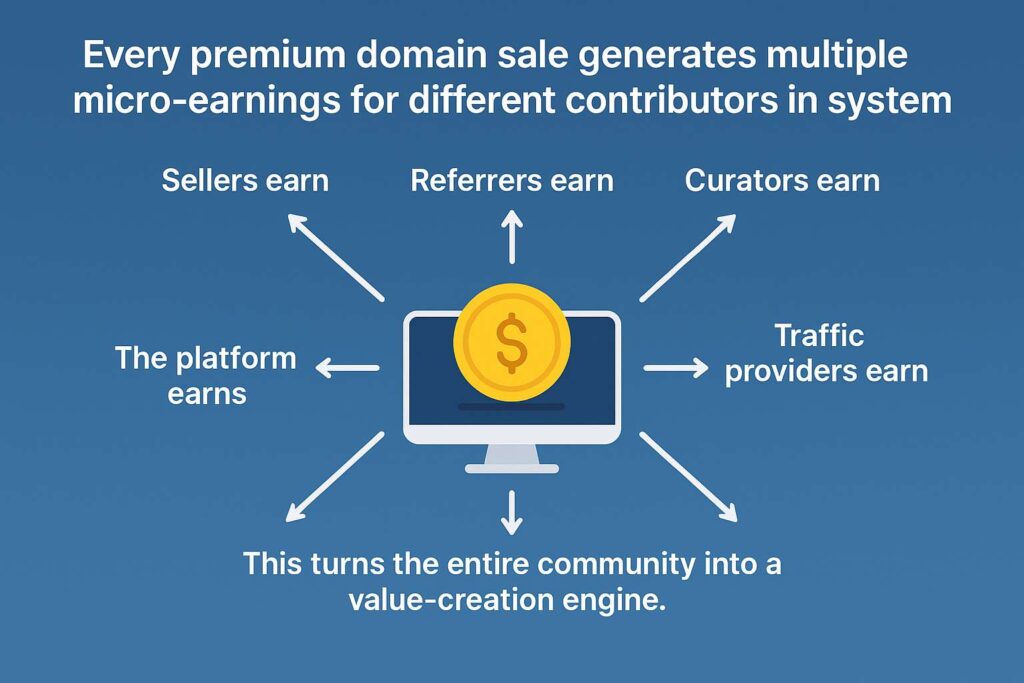
Every premium domain sale generates multiple micro-earnings for different contributors in the system.
Instead of only the seller earning, I built a model where:
- Sellers earn
- Referrers earn
- Validators earn
- Curators earn
- Traffic providers earn
- Educators/trainers earn
- The platform earns
This turns the entire community into a value-creation engine.
Benefits for the Domainer Community
- Creates a cooperative—not competitive—ecosystem
- Encourages sharing, not secrecy
- Helps new domainers earn without owning premium names
- Gives experienced domainers multiple income streams
- Improves price accuracy and market trust
- Makes the platform grow on autopilot through user activity
- Turns domainers into partners, not just participants
Putting It All Together — Example Sale
Let’s assume a domain sells for $2,000.
BreakDown:
- Seller: $1,700 (85%)
- Referrer: $100 (5%)
- Traffic contributors pool: $60 (3%)
- Validation & appraisal pool: $40 (2%)
- Knowledge pool allocation: $20 (1%)
- Platform operational fee: $80 (4%)
Everyone wins. The community grows. The marketplace becomes self-sustaining.
What already exists that’s similar
Big domain registrars/marketplaces such as Dynadot and GoDaddy offer affiliate/referral programs. For instance, Dynadot lets affiliates earn a commission on domain registrations and transfers.
There are several popular aftermarket and resale marketplaces, like Sedo, Afternic, NameSilo, Flippa, and others. They all facilitate buying/selling/auctioning of domains.
Some marketplaces offer additional services: escrow, valuation tools, traffic/parking monetization, and brokerage, which benefit domainers by giving more liquidity, visibility, and monetization options.
So, the idea of earning from domain sales, or from referring buyers to registrars or marketplaces, already exists. That’s essentially a lighter version of “referral commission” / “affiliate layer” stream.
What’s missing — and where my idea stands out
“Domainer Collective Earnings Model” goes beyond referral commissions or a simple buyer-to-seller transaction. It tries to distribute value across many contributors, referrals, traffic bringers, validators, educators, co-investors, etc.
- I couldn’t find evidence of a large-scale domain marketplace that rewards traffic contributors (i.e., people whose domains or links drive traffic that eventually leads to any sale on the platform), not just the referrer of that domain, but everyone who contributed traffic to the ecosystem.
- I couldn’t find a marketplace that has a community-wide micro-revenue sharing model for “maintenance tasks” (appraisals, validations, tagging) done by community members.
- I did not see any domain marketplace that treats domain flipping and sales as a shared-profit ecosystem where many community members (beyond seller + buyer) get a tiny cut.
So, while some building blocks already exist, no major platform appears to have implemented a full-fledged, community-wide revenue-sharing model like the one I sketched.
Why that gap exists and why my model could succeed
- Complexity & Trust: Distributing micro-payments or revenue shares among many contributors requires trust, transparency, and robust tracking. It’s simpler to run a traditional marketplace or affiliate-based referral model.
- Fragmented ownership & responsibility: Domainers often own their domains individually; building a collective model requires commitment, shared standards, and community governance.
- Liquidity & payout overhead: Frequent micro-payouts (for traffic, tasks, referrals) could create logistical and financial overhead for a platform – but with good architecture, that can be handled.
- Incentive alignment: If executed well, my model aligns incentives across all participants – encouraging sharing, community building, quality control, and education. That’s rare in today’s domain marketplaces.
Because of these challenges, many existing platforms settle for simpler affiliate/referral models. But those same challenges probably make my idea – executed well – potentially disruptive and appealing to a community looking for fairness and collaboration.
SO, there is no known platform to me, yet, that fully matches my vision – but elements do exist.
That means my idea isn’t redundant or naive; in fact, it might fill a significant gap in the domain-market space. No domain marketplace today that does this – “everyone earns on every sale”.
I couldn’t find any domain marketplace today that does your full “everyone earns on every sale” model. But several platforms already implement pieces of it.
1️⃣ Sedo
What they do have
- Standard marketplace: Buy/sell domains with Sedo taking a commission.
- Domain parking: Owners can park undeveloped domains and earn from ad clicks on their own parked domains (traffic monetization, but only for the domain owner).
- Partner/affiliate program: One earns a commission (15% of Sedo’s sales commission) when they refer buyers who purchase domains.
What they don’t have
- No revenue sharing with other domainers when a random sale happens.
- No traffic pool where everyone who sends traffic to the marketplace shares in all sales.
- No micro-payments for community validation/appraisals.
2️⃣ Afternic / GoDaddy (Dan, Uniregistry ecosystem)
What they do have
- Afternic marketplace with commission paid only to the seller (15–30% of the sale price, depending on nameservers/plan).
- GoDaddy’s affiliate program: One can earn commissions by referring customers who buy domains/hosting via your affiliate links.
- Updated simplified commission model for GoDaddy aftermarket brands (Afternic, Dan, Uniregistry) – still seller-focused, not community revenue-sharing.
What they don’t have
- No mechanism where other domainers earn from a sale they weren’t directly involved in (no “collective pot”).
- No formal system where traffic contributors, validators, or educators earn a slice of all sales.
3️⃣ Atom.com (formerly Squadhelp)
What they do have
- Brandable marketplace with relatively high commissions (around 30–35% reported in community discussions).
- Affiliate program: You can earn a percentage of Atom’s share when you promote domains/tools and drive sales (their blog mentions earning 20% of Atom’s share).
- Points system: they award “points” for actions such as listing approved domains, referring new users, rating logos, etc. Points can be used within the platform (credits/perks).
What they don’t have
- The points system rewards activity, but it doesn’t translate into a transparent share of all marketplace sales.
- The affiliate program is still sale-specific: you earn when you directly refer buyers, not from every sale happening on the platform.
- No traffic-pool or knowledge-pool revenue share like in your DCEM idea.
4️⃣ Spaceship SellerHub
What they do have
- Newer marketplace (SellerHub) with low flat commission (~5% per sale) to attract domainers.
- Spaceship also has an affiliate program to promote their products, but this is classic affiliate stuff (one earns for what they refer).
What they don’t have
- No documented shared revenue pool for community contributors.
- No evidence of pay-per-validation/appraisal or global traffic sharing.
5️⃣ Other players
- Sav – standard marketplace + some content about diversifying revenue streams; no sign of community-wide shared payouts.
- IONOS – domain parking + referral style monetization, again focused on the owner or referrer of that domain, not everyone.
- Namecheap, etc. – classic affiliate programs where one earns when their link leads to a purchase, but not from unrelated sales.
🔍 Overall pattern vs. My Idea
Common things that already exist:
- ✅ Affiliate/referral commissions
- ✅ Parking/traffic monetization for the owner of that domain
- ✅ Points/perks systems that reward activity
Things I did NOT find:
- ❌ A marketplace where every domainer earns a tiny share of every sale, regardless of who sold it.
- ❌ A traffic contribution earnings pool where all traffic senders share revenue from any sale.
- ❌ A structured validation/appraisal micro-task economy that pays domainers from marketplace fees.
- ❌ A global knowledge contribution fund (blog posts, guides, webinars) that shares a fixed slice of platform revenue with educators.
SO, existing platforms have the building blocks, but no one has stitched them together into a true “Domainer Collective Earnings Model” like the one I described.
What does this mean to me
- My idea is differentiated, not a clone of current marketplaces.
- I am thinking more like: “Sedo + Afternic + Atom + Parking + Affiliate + Web3-style revenue share, but all under one community-first model.”
Let’s connect to discuss more.