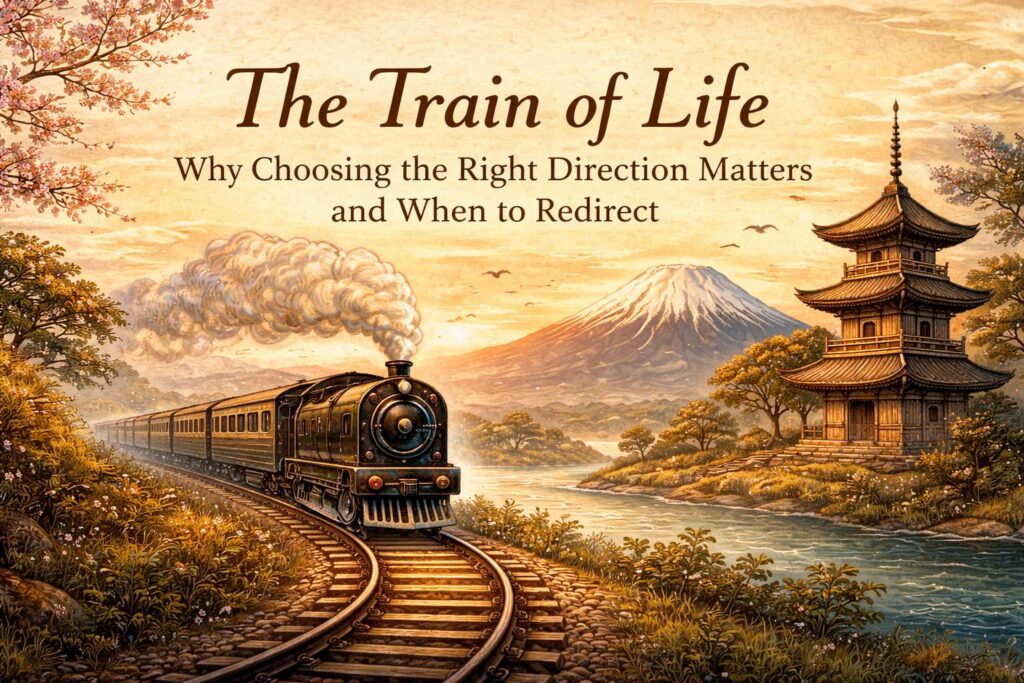
The Train of Life: Why Choosing the Right Direction Matters and When to Redirect
Introduction
There is a well-known Japanese legend that says:
“If you get on the wrong train, get off at the nearest station; the longer it takes you to get off, the more expensive the return trip will be.”
At first glance, this sounds like practical travel advice. But the wisdom behind this simple statement goes far beyond railway journeys.
It speaks about life.
Situations in life are very similar to railway stations, and life itself resembles a long train journey. Along the way, we board different trains—choices, relationships, careers, habits, and beliefs—that take us toward different destinations.
While the final destination of life may eventually be the same for everyone, what truly matters is which train we choose, when we change direction, and how meaningful the journey becomes along the way.
Life Is a Journey – Just Like a Train Ride
Imagine standing at a railway station. Multiple trains are arriving and departing. Each train has its own route, speed, and destination.
Life is very similar.
Throughout our lives, we board many “trains,” such as:
The education we pursue
The career we choose
The relationships we build
The habits we develop
The values we adopt
Each of these decisions determines the direction in which our life journey moves.
Sometimes we choose the right train. Sometimes we board the wrong one.
And often, we only realize it after the train has already traveled quite far.
Life’s Railway Stations: Moments of Pause
Every train journey includes stations where passengers can pause, get off, or change trains.
Life also gives us such stations.
These stations appear in the form of moments that force us to reflect, such as:
A job that no longer feels fulfilling
A business idea that fails
A health warning
A difficult relationship
A moment of deep self-realization
A sudden life change
These situations are not just obstacles.
They are life’s railway stations.
They offer us a chance to pause and ask an important question:
Am I on the right train?
Why People Stay on the Wrong Train
One of the most interesting aspects of human behavior is that even when people realize they are on the wrong train, they often continue traveling.
Why does this happen?
Fear of Starting Over
Changing direction can be uncomfortable. Getting off the train may mean beginning a new journey from an unfamiliar station.
Social Expectations
Society often expects people to stay on a fixed path. Changing careers, lifestyles, or ambitions can invite criticism or doubt.
The Sunk Cost Trap
Many people think:
“I have already invested so many years in this path.”
Because of this, they continue moving forward—even when the direction feels wrong.
Lack of Reflection
In the busy routine of modern life, people rarely pause to examine whether their journey still aligns with their values and aspirations.
The Cost of Staying on the Wrong Train
The Japanese proverb reminds us that the longer we stay on the wrong train, the more expensive the return journey becomes.
In life, this cost may appear in different ways:
Years spent in an unfulfilling career
Emotional exhaustion from unhealthy relationships
Missed opportunities to pursue meaningful passions
Stress and declining health
Regret over unrealized potential
Time is the most valuable resource we have.
Unlike money, it cannot be refunded.
When Should You Redirect Your Journey?
Knowing when to change direction is one of the most important life skills.
Here are some signs that it may be time to step off the train and reconsider your path.
When Your Work Drains You Instead of Energizing You
Everyone experiences difficult days, but if your work consistently leaves you feeling exhausted and unmotivated, it may signal a misalignment with your purpose.
When Growth Stops
The right train should take you somewhere new.
If you feel stuck without learning or personal development, it may be time to explore a new direction.
When Your Values No Longer Match Your Path
As people grow, their values evolve. A path that once felt meaningful may no longer resonate with who you have become.
When Your Inner Voice Keeps Warning You
Often, we intuitively know when something is not right. Ignoring that inner voice for too long can lead to regret.
Switching Trains Is Not Failure
Many people believe that changing direction in life means they have failed.
But in reality, switching trains often demonstrates courage and self-awareness.
History is filled with individuals who changed paths before achieving success.
People often redirect their journeys by:
Changing careers
Starting businesses later in life
Returning to education
Pursuing creative passions
Transforming unhealthy lifestyles
Every train ride teaches something valuable.
Even the wrong trains contribute to wisdom and growth.
The Final Destination Is the Same
There is another powerful truth hidden within the metaphor of life as a train journey.
No matter which train we take, the final destination of life is the same for everyone.
Eventually, every journey reaches its end.
What truly matters is not how fast we reach the destination.
What matters is:
How beautiful the journey was!
What experiences did we gather?
What lessons did we learned?
Who traveled alongside us?
How meaningful did our time on the train feel?
Life is not just about reaching the destination.
It is about experiencing the journey fully.
Embracing the Beauty of the Journey
Every life journey includes:
Wrong trains
Missed stations
Unexpected delays
Sudden changes of direction
These experiences are not mistakes.
They are part of the story.
Sometimes the most meaningful moments occur during unexpected stops or difficult transitions.
When we learn to see life this way, we begin to appreciate the journey rather than constantly worrying about the destination.
Final Thoughts
The Japanese proverb about trains offers a powerful lesson for life.
Choosing the right direction matters, but recognizing when to redirect matters even more.
Life will present many trains and countless stations.
Some trains will take us exactly where we hoped to go.
Others will teach us lessons we never expected.
The wisdom lies in knowing when to continue the journey and when to step off and choose another path.
Because in the end, life is not measured by the distance we travel, but by how meaningful the journey becomes along the way.