
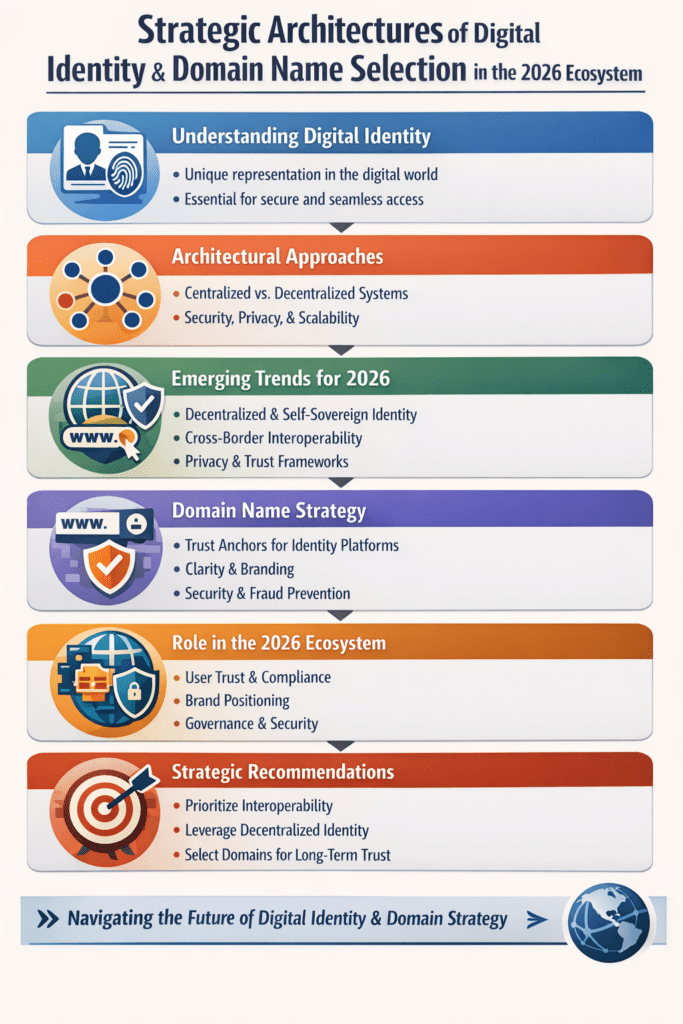
The digital identity landscape of 2026 has undergone a fundamental transformation, evolving from a period of simple keyword-based navigation to a complex ecosystem defined by brand authority, linguistic precision, and rigorous regulatory compliance. In this environment, a domain name serves as the primary foundational asset of any business venture, acting not merely as a technical pointer within the Domain Name System (DNS) but as a critical signaling mechanism for credibility, security, and brand essence. As search engines and artificial intelligence systems increasingly prioritize clarity and intent over simple keyword density, the process of choosing a domain name has become an exercise in strategic architecture. This report examines the multi-dimensional facets of domain selection, integrating cognitive psychology, linguistic engineering, technical integrity, and the specific regulatory demands of global and regional markets.
The Cognitive Psychology of Digital Memorability
The efficacy of a domain name is primarily determined by its ability to bypass cognitive friction and embed itself within the long-term memory of the consumer. Research suggests that human cognition is optimized for simplicity, and in an era of information saturation, the “KISS” (Keep It Short and Simple) principle has transitioned from a recommendation to a structural requirement for digital survival. The mental effort required to process, recall, and type a domain name directly correlates with user retention and the success of word-of-mouth marketing.
Brevity as a Structural Advantage
Statistical evaluations of global web traffic highlight a clear correlation between brevity and success. Among the top 250 websites worldwide, the average domain length is a remarkably concise 6.4 characters. Short names are inherently more versatile, fitting seamlessly into mobile user interfaces, app icons, and restricted social media headers. In practice, the 2026 standard dictates that a domain should ideally remain under 12 characters, with a maximum limit of 14 to 17 characters before recall rates begin to decline sharply. Longer strings, such as hypothetical descriptive URLs like “videoconferencingtoolonline.com,” suffer from high typographical error rates and are often ignored by users who prioritize efficiency.
The Phonetic Radio Test and Verbal Sharing
The “radio test” remains the definitive diagnostic for phonetic clarity. This test posits that a domain must be understood and accurately typed by an individual who has only heard it spoken aloud, without the benefit of visual aids. If a name requires the spelling out of specific letters or clarification of unusual phonemes—for example, the confusion between “fiverr.com” and “finance.com”—it creates a barrier to entry. Names like “PayPal” or “Zoom” pass this test because they sound exactly as they are spelled, minimizing the risk of “traffic leakage” to competitors or parked pages.
| Cognitive Metric | Target Threshold | Strategic Impact |
| Character Length | 6–12 characters | Reduces typos; enhances mobile UX |
| Syllable Count | 1–3 syllables | Facilitates rapid verbal sharing |
| Phonetic Alignment | 1:1 Sound-to-Spelling | Passes the radio test; minimizes leakage |
| Word Count | 1–2 words | Enhances visual and mental recall |
Linguistic Engineering and the Science of Sound Symbolism
Beyond simple memorability, advanced brand strategists in 2026 utilize sound symbolism—the study of how specific phonemes convey meaning and evoke emotions independent of their dictionary definitions. This linguistic science allows a brand to communicate its core attributes, such as power, speed, or approachability, through the very sounds of its domain name.
Phonemic Cues and Consumer Evaluation
Individual units of sound, or phonemes, serve as building blocks that trigger automatic cognitive evaluations. This process is effortless and often occurs outside of conscious awareness, yet it significantly influences purchase intentions and brand attitudes. Vowel sounds, for instance, are mapped on a phonetic scale based on tongue position, ranging from high-front to low-back.
Research across various languages has confirmed a consistent hierarchy of sound-based associations. High-front vowels, such as the “ee” sound in “flea” or the “i” in “kiss,” are universally associated with attributes of smallness, lightness, speed, and femininity. In contrast, low-back vowels, such as the “oo” in “boot” or the “o” in “boat,” connote size, power, and durability. For a tech startup aiming to signal agility, a domain featuring high-front vowels is linguistically optimal, whereas an automotive or heavy machinery firm would benefit from the gravitas provided by low-back vowels.
Consonantal Structure and Brand Perception
The choice between plosive and fricative consonants further refines a brand’s auditory narrative. Plosives, also known as “stops” (including /k/, /g/, /p/, /t/), involve a complete blockage of airflow followed by a sharp release, which conveys strength, reliability, and precision—traits found in domains like “Kodak” or “Google”. Fricatives, such as /f/, /s/, /v/, and /z/, involve a continuous flow of air through a narrow passage, suggesting fluidity, softness, and warmth.
| Phoneme Category | Example Sounds | Inferred Attributes | Strategic Application |
| High-Front Vowels | /i/, /e/ | Speed, smallness, lightness | SaaS, Tech, Cosmetics |
| Low-Back Vowels | /o/, /u/ | Power, size, durability | Industrial, Automotive |
| Plosive Consonants | /k/, /g/, /p/, /t/ | Strength, precision, action | Hardware, Enterprise |
| Fricative Consonants | /f/, /s/, /v/, /z/ | Approachability, warmth | Lifestyle, Wellness |
Linguistic tools such as alliteration (Coca-Cola), assonance (PayPal), and consonance (KitKat) enhance the “euphony” or aesthetic appeal of the domain, making it more rhythmic and therefore easier for the brain to encode and retrieve.
Technical Integrity and Structural Best Practices
While creativity drives the naming process, the technical limitations of the Domain Name System (DNS) provide the essential boundaries for any digital address. In 2026, adhering to these technical standards is vital for maintaining cross-browser compatibility and ensuring that automated security filters do not flag a domain as potentially malicious.
Permitted Characters and Syntax Rules
The DNS allows for the use of letters (a-z), digits (0-9), and hyphens (-). It is critical to note that domain names are case-insensitive, meaning “MyBrand.com” and “mybrand.com” are functionally identical. However, the use of hyphens and numbers is heavily discouraged in modern naming strategies. Hyphens cannot be placed at the beginning or end of a domain name, and double hyphens are generally restricted or disallowed by many registrars.
The presence of numbers and special characters often serves as a “low-trust” signal. Historically associated with spam or disposable content, domains containing hyphens or numeric strings (e.g., “best-cakes-2026.com”) are often met with higher skepticism by both users and modern security algorithms. Furthermore, the visual confusion created by double letters at the junction of two words (e.g., “presssetup.com”) significantly increases the likelihood of typographical errors, potentially sending traffic to competitors or malicious typosquatters.
Length and Labels
Technical specifications allow for a domain label to be up to 63 characters long, with the total fully qualified domain name (FQDN) reaching approximately 253 characters. Despite these expansive limits, the strategic imperative remains brevity. Every additional character beyond the 14-character threshold increases cognitive friction and decreases the efficiency of mobile navigation.
Strategic Navigation of Top-Level Domains (TLDs)
The selection of a Top-Level Domain (TLD) or extension is no longer a secondary consideration but a core component of brand positioning. By 2026, the internet’s naming system has bifurcated into the global legacy of the.com extension and the specialized signaling of newer, niche TLDs.
The Continued Dominance of.com
The.com extension remains the global “gold standard” for trust and recognition. Because the majority of users instinctively append “.com” to any brand name they hear, these domains enjoy significant “type-in traffic” and inherent authority. For any business with global reach or established commercial intent, securing the.com version of their brand is considered a fundamental step in brand protection.
The Emergence of Tech and Niche Extensions
The rise of artificial intelligence has propelled the.ai extension into the mainstream, with over 1 million registrations recorded by early 2026. Originally a country-code TLD,.ai is now categorized by search engines as a generic TLD and is favored by software developers and AI startups to signal technological focus. Similarly, the.io extension has become synonymous with the SaaS and developer community, while extensions like.store or.shop are increasingly utilized to signal clear e-commerce intent.
| TLD Category | Trust Rating | Primary Use Case |
| .com | 70%–95% (Extreme) | Global business, high authority |
| .org | 80%–90% (High) | Non-profits, education, community |
| .ai /.io | Moderate to High (Sector Specific) | Technology, AI, SaaS, Startups |
| .net /.co | Moderate | Tech-adjacent, generic commercial |
| .in | High (Regionally Specific) | Indian domestic market, local SEO |
Search Engine Classification and AI Discovery in 2026
The relationship between domain names and Search Engine Optimization (SEO) has undergone a paradigm shift. In 2026, search engines and AI-driven summary systems use domains as primary classification signals rather than simple ranking boosters. The “outdated myth” that keywords in a domain directly cause a site to rank higher has been replaced by a more nuanced understanding of site legitimacy and intent clarity.
Intent Alignment and Site Stability
Modern discovery systems function as classification engines first. Before content quality is even assessed, a system evaluates the domain to determine if the site appears stable, tied to a real entity, and aligned with the user’s intent. A domain that looks spammy or uses confusing gimmicks can increase the “skepticism threshold” of these automated systems, leading to lower prioritization in search results.
Consistency over time is now more valuable than “clever” naming hacks. Frequent domain changes break critical continuity signals—such as link equity and historical recognition—and can lead to a loss of authority in AI selects. Long-term stability in a primary domain is essential for building the references and mentions that modern AI systems require to select a site as a source for answers.
Keywords vs. Brandability in Search
While incorporating keywords can still aid in contextual understanding, the 2026 consensus emphasizes prioritizing brandability. Brandable names are easier to trademark and provide the flexibility needed for a business to scale. For example, the domain “Amazon.com” successfully transitioned from a bookstore to a global logistics giant, whereas a descriptive domain like “Joe-Buy-Books-Online.com” would have created an insurmountable barrier to expansion.
Legal Due Diligence and Trademark Clearance
The financial and operational risks of a domain name misstep are substantial, including domain takedown, potential damages for trademark infringement, and charges of cybersquatting. Rigorous legal clearance is a non-negotiable step in the selection process.
The Multi-Phase Search Process
A preliminary “knock-out” search of federal and state databases (such as the USPTO’s TESS system or IP India) is the starting point to identify obvious exact-match conflicts. However, legal clearance must extend beyond exact matches, as trademarks are protected against any name that creates a “likelihood of confusion”.
Strategic clearance must evaluate several factors:
- Phonetic and Visual Similarity: Do the names sound alike or look similar when written? Even different spellings (e.g., “Bologna” vs. “Baloney”) can constitute infringement if they cause consumer confusion.
- Commercial Impression: Do the names create a similar conceptual meaning or commercial “vibe”?.
- Relatedness of Goods/Services: Confusion is most likely when two similar marks operate in the same industry or use the same sales channels.
- Common Law Search: This involves scanning the broader internet, social media, business directories, and trade journals for unregistered trademarks that are still in active use.
Cybersquatting and Bad Faith
Under the Anti-Cybersquatting Consumer Protection Act (ACPA) and the Uniform Domain-Name Dispute-Resolution Policy (UDRP), registering a domain in “bad faith” to profit from a competitor’s trademark is a prosecutable offense. A business that registers a domain with an innocent, legitimate reason—and is the first to do so in good faith—is generally protected, provided they do not otherwise infringe on the trademark’s rights.
Domain Acquisition and the Secondary Market
As the primary pool of.com names has reached saturation, many organizations must look to the secondary market to acquire their desired digital identity.
Discovery and Ownership Identification
The process begins with a WHOIS lookup to identify the current registrant. While privacy laws such as GDPR have redacted many personal details, most registrars facilitate communication through standardized contact forms or redirected emails.
Market valuation for a taken domain is influenced by several factors:
- Domain Age: Older domains are often perceived as more authoritative and can command higher prices.
- Keyword Demand: Names containing high-value, industry-specific keywords are highly sought after.
- Market Comparables: Valuation often involves looking at what similar domains in terms of length and extension have sold for in the recent past.
Negotiation and Transfer
Hiring a professional domain broker can provide significant advantages, including the ability to negotiate anonymously and ensuring that the final payment and transfer are handled through secure escrow services. In scenarios where a domain is about to expire, “backordering” or “drop-catching” services can be employed. These specialized companies use high-speed automated systems to register the domain the moment it is deleted from the public space, a process that is virtually impossible for a manual user to perform successfully.
Cross-Platform Identity and Social Media Cohesion
In 2026, a domain name does not exist in isolation; it must be perfectly synchronized with social media handles to build a seamless brand identity. Consistency across platforms fosters trust and ensures that users can find the brand regardless of the channel they choose to use.
Strategies for Unified Handles
When a brand’s preferred social media handle is already taken, several creative strategies can maintain brand essence without confusing the consumer:
- Institutional Suffixes: Adding “HQ,” “Inc,” or “Official” (e.g., @BrandHQ) provides a sense of legitimacy.
- Action Prefixes: Using “Get,” “Try,” or “Join” (e.g., @TryBrand) acts as a call-to-action.
- Industry Descriptors: Appending terms like “App,” “Store,” or “Studio” (e.g., @BrandStudio) clarifies the business type.
- Punctuation and Variation: While underscores and dots are permitted on platforms like Instagram, they are often harder to remember and should be used as a last resort.
| Platform Handle Strategy | Example | Use Case |
| Action Prefix | @TryIgnition | SaaS, Apps, CTAs |
| Institutional Suffix | @Bestow_Inc | Corporate, Professional |
| Descriptive Suffix | @DatingCom | Direct link to domain |
| Descriptive Prefix | @RealAgents | Service industries |
| Geographic Tag | @BrandNYC | Local or regional focus |
The Indian Digital Identity: NIXI and the.in Ecosystem
For brands operating within or targeting the Indian market, the.in extension offers a distinct strategic advantage while carrying specific regulatory obligations.
Local Trust and Search Performance
The.in domain, India’s country-code TLD managed by the National Internet Exchange of India (NIXI), signals immediate local relevance. Government portals (e.g., uidai.gov.in) and major financial institutions (e.g., sbi.co.in) have established the extension as a symbol of institutional confidence and legitimacy. From an SEO perspective,.in domains receive automatic geotargeting benefits, causing search engines to prioritize them for queries originating within the Indian subcontinent.
The 2026 NIXI Compliance Mandate
In 2026, NIXI has strictly enforced mandatory KYC (Know Your Customer) and e-KYC verification for all.in registrants to combat fraud and enhance cybersecurity. All domain holders must verify their identity within 7 days of registration or renewal, or the domain is placed on “SERVERHOLD” status, effectively taking the associated website offline.
Key 2026 NIXI Regulations include:
- Mandatory e-KYC: Indian residents must use the DigiLocker platform to verify identity using Aadhaar, PAN, or Passport.
- Privacy Prohibition: NIXI has banned the use of “Proxy” or “Privacy” services for.in domains. Real registrant details, including name, city, and state, must be visible on the public WHOIS database to ensure accountability.
- Communication Restrictions: Temporary or highly encrypted email providers (e.g., ProtonMail, Mailinator) are prohibited for domain contacts; only permanent, verifiable email addresses are accepted.
- Foreign Registrant Requirements: Foreign individuals or organizations must provide a verified passport and a signed declaration outlining their legitimate business connection to India (e.g., serving Indian customers or having a local office).
| Registrant Entity | Mandatory Documents (India) | Mandatory Documents (Foreign) |
| Individual | Aadhaar / PAN / Passport | Passport (Mandatory) + Government ID |
| Company | Certificate of Incorporation + Signatory ID | Business Reg. Document + Indian Connection Declaration |
| NGO/Trust | Registration Cert + Signatory ID | Registration Doc + Proof of Indian Ties |
Security Infrastructure as a Baseline for Trust
A domain name in 2026 is the anchor for a suite of security protocols that are essential for maintaining user trust and preventing the erosion of brand reputation.
DNSSEC and Cryptographic Authentication
The broad adoption of Domain Name System Security Extensions (DNSSEC) is now a standard expectation for credible brands. DNSSEC adds cryptographic authentication to DNS lookups, mitigating risks such as cache poisoning or “man-in-the-middle” attacks where an attacker might hijack a domain’s traffic.
Encryption and Authentication Protocols
The move toward a 100% encrypted web means that HTTPS is a baseline standard; unsecured HTTP websites now trigger prominent browser warnings that undermine credibility. Furthermore, domains must be configured with anti-spoofing protocols such as SPF (Sender Policy Framework), DKIM (DomainKeys Identified Mail), and DMARC (Domain-based Message Authentication, Reporting, and Conformance). These protocols ensure that scammers cannot forge emails from the brand’s domain, protecting both the customer from phishing and the brand from the reputational damage associated with deceptive practices.
Conclusion: The Integrated Strategic Framework
The selection of a domain name in the 2026 ecosystem is a complex, multi-layered strategic process that integrates linguistic science, cognitive psychology, structural integrity, and global legal and regulatory requirements. A successful domain choice must satisfy the human brain’s need for simplicity and phonological appeal while meeting the technical and security demands of modern AI-driven discovery systems.
By prioritizing brandability over temporary SEO advantages, conducting exhaustive legal clearance across federal and common law databases, and ensuring strict compliance with regional mandates like those of NIXI in India, an organization can secure a digital identity that is both robust and scalable. Ultimately, the domain name is the most important piece of digital real estate a brand will ever own—it is the foundation upon which trust, authority, and global presence are built. In a world increasingly mediated by automated discovery, the clarity and credibility of that foundation will determine a brand’s long-term success or its eventual obsolescence.